
Big ideas, real impact.

One day a man was walking along the beach when he noticed a boy picking something up and gently throwing it into the ocean.
Approaching the boy, he asked, “What are you doing?” The youth replied, “Throwing starfish back into the ocean. The surf is up and the tide is going out. If I don’t throw them back, they’ll die.”
“Son,” the man said, “don’t you realize there are miles and miles of beach and hundreds of starfish? You can’t make a difference!”
After listening politely, the boy bent down, picked up another starfish, and threw it back into the surf. Then, smiling at the man, he said…” I made a difference for that one.”
Indigo Fox & Olive Co. was built on a foundation of compassion.
From our beginnings as State of Texas permitted wildlife rehabilitators, we have always believed that even the smallest and most vulnerable amongst us are deserving of respect. Our namesake bloomed from that belief. Years ago, we got an alert from some friends that a homeowner’s dog had brought a pair of baby unknown animals to it’s house, and that people were telling the finder they were dealing with kittens and to put them back. There were several problems with this. First, they weren’t kittens, and second, since the finder had no idea where their dog had found them, they had no way of returning them. And third, people who had an idea of what they were weren’t certain, and didn’t have the legal permits to possess them.
With a lot of thanks to our friends for alerting us, and a lot of grace, we ended up with two perfect two-week-old fox kits. Originally named Olive, a beautiful female, and Pop-eye, a lovely little male (we name our animals alphabetically to help keep track of how many come in throughout the year and make discussions about treatments and feedings more efficient), we slowly learned that Pop-eye would keep his blue eye color. We gave him a name that honored his very unique eye color. Indigo. Both Indigo and Olive were successfully released on property totaling over 500 acres. The owners of these properties are amazing stewards of our natural spaces, and indeed Indigo and Olive are very fortunate to call that space home today.
Indigo and Olive teach us that protecting wild spaces, and understanding how humans and animals live alongside each other is so important. Today, we still advocate for the vulnerable wildlife around us through wildlife rehabilitation, education, and habitat management as we work to help people learn human impact on the environment, and things we can do in our own homes to improve life for all. Come learn nature with us!
Building Compassion through Experience
All creatures deserve consideration and understanding. One of the most effective tools to building in that compassion and care is through first hand experience. We have watched students go from total fear of dragonflies to hoping to be lucky enough to have one land on their out-stretched palm! The bridge between fear and hope is knowledge. Here’s a few entertaining facts about the animals around us:
Did you know that dragonflies have a 97% success rate in capturing prey, and that they eat lots of mosquitoes? Or that baby dragonflies (called nymphs) can remain babies for years? This is why clean water is so important for strong dragonfly populations!
Did you know that bobcats are obligate carnivores (meaning they must eat animal proteins to stay healthy) but coyotes will eat meat AND fruit? When there’s less fruit for coyotes to eat (think fall and winter), bobcats and coyotes put more competition pressure on each other. Coyotes will happily eat native persimmons and plums when they’re available.
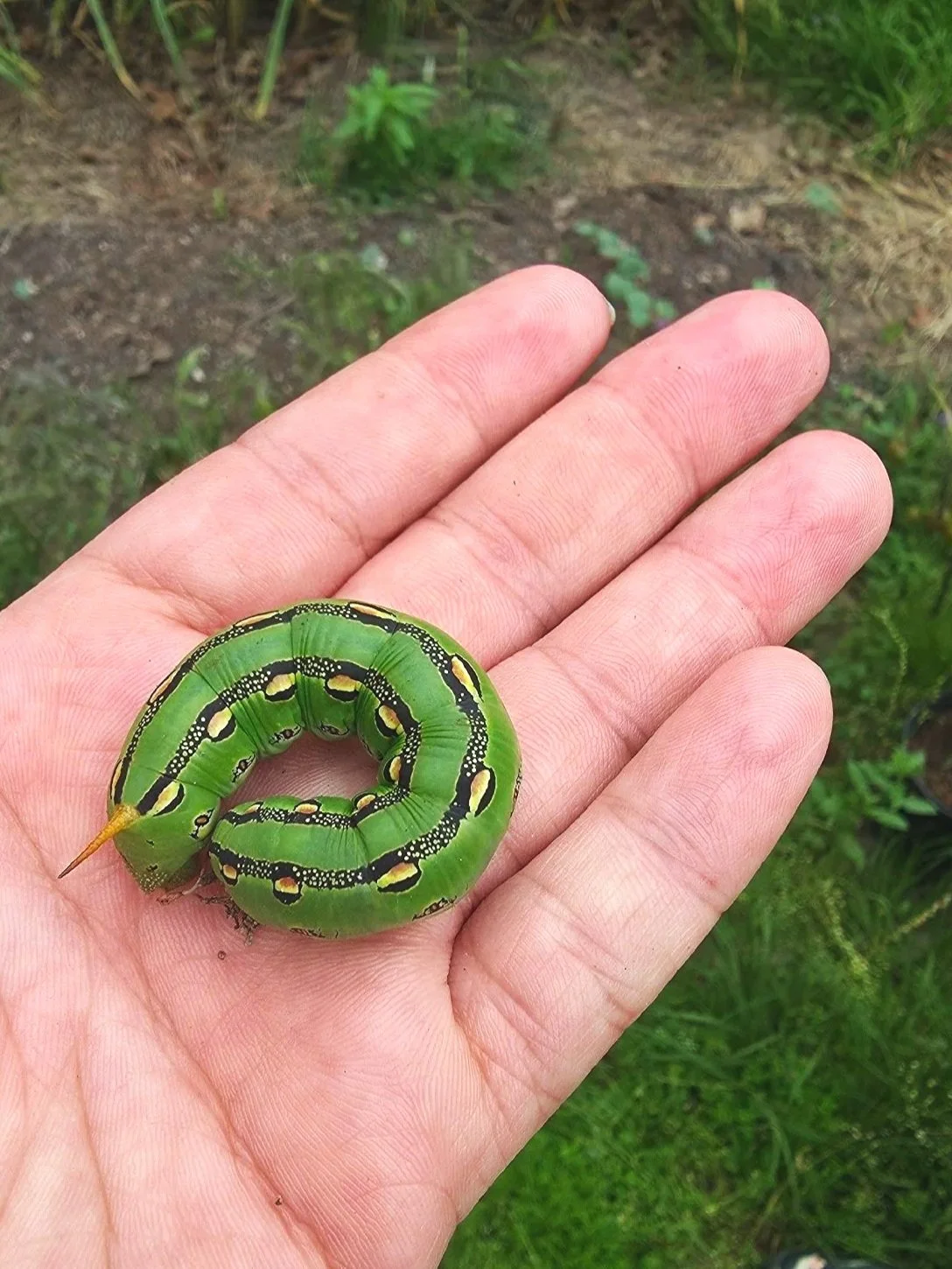
Caterpillars can be scary (especially the big, chonky ones!) until we learn that they turn into moths and butterflies. Did you know their importance to the thousands of baby birds raised in Texas every year? We are located in the Central flyway, the biggest flyway in North America, and thousands of migrating birds stop in Texas to raise their young.
Did you know caterpillars completely deconstruct themselves to become moths and butterflies, or that there is scientific evidence indicating moths and butterflies remember being caterpillars? The caterpillar in my palm is a White-lined-sphinx, and it likes to eat native primrose, not tomatoes.
We go into greater detail on all these facts in our programs! We’d love for you to come learn with us!
Ready to Learn Nature With Us?
Complete the form below and let’s pioneer the next wave of understanding together.